Paying a nanny or caregiver under the table can feel like the simpler option at first. No tax calculations or paperwork, just straightforward under-the-table cash payments.
But what starts simple can get complicated and create real headaches for you and your employee down the road. Employers who pay under the table can get audited and be subject to back taxes, fines, and other penalties. And if your employee is ever audited or files for benefits, it could come back to you.
The good news? Getting back on track is more straightforward than it sounds. There are clear steps to help you catch up on previous under-the-table payments, required taxes, and move forward with confidence.
What does "under-the-table" payment mean?
When people talk about "under-the-table" pay, they’re talking about wages that aren’t reported to the IRS and don’t include required tax withholdings. The expression comes from the idea that these payments are made in secret, or literally hidden under a table.
This can happen in household roles like nannying, caregiving, tutoring, or housekeeping, often because families didn't know what was required.
In some cases, it’s intentional. Either way, the path forward is the same.
How can I tell if I've been paying my nanny or household employee under the table?
You probably already know the answer. But if you're unsure, here's a quick gut check.
Did your employee complete a Form W-4 and Form I-9 when they started?
These forms are required when you bring on a household employee. The W-4 tells you how much federal income tax to withhold; the I-9 verifies they can legally work in the U.S.
Do you track their hours and wages consistently?
Keeping a clear record of hours worked and pay issued is part of being a compliant household employer.
Do you withhold and pay required taxes?
If you're not withholding Social Security, Medicare, and applicable state taxes from each paycheck, and remitting them to the appropriate agencies, you may not be fully compliant.
Do you provide a paystub each pay period?
Employees are entitled to a record of their earnings and deductions. If you're handing over cash without documentation, that's a sign things may need to be formalized.
Do you have a written employment agreement in place?
This one's not legally required in every state, but it's strongly recommended. A written agreement documents hours, wages, duties, and expectations for both parties.
If you answered "no" to any of the above, you may not be fully set up for compliant household payroll, but don't worry, it's fixable.
Comparing under-the-table pay signs versus compliant over-the-table payroll
Ready to pay your household employee on the books? Poppins makes it simple. Get started today.
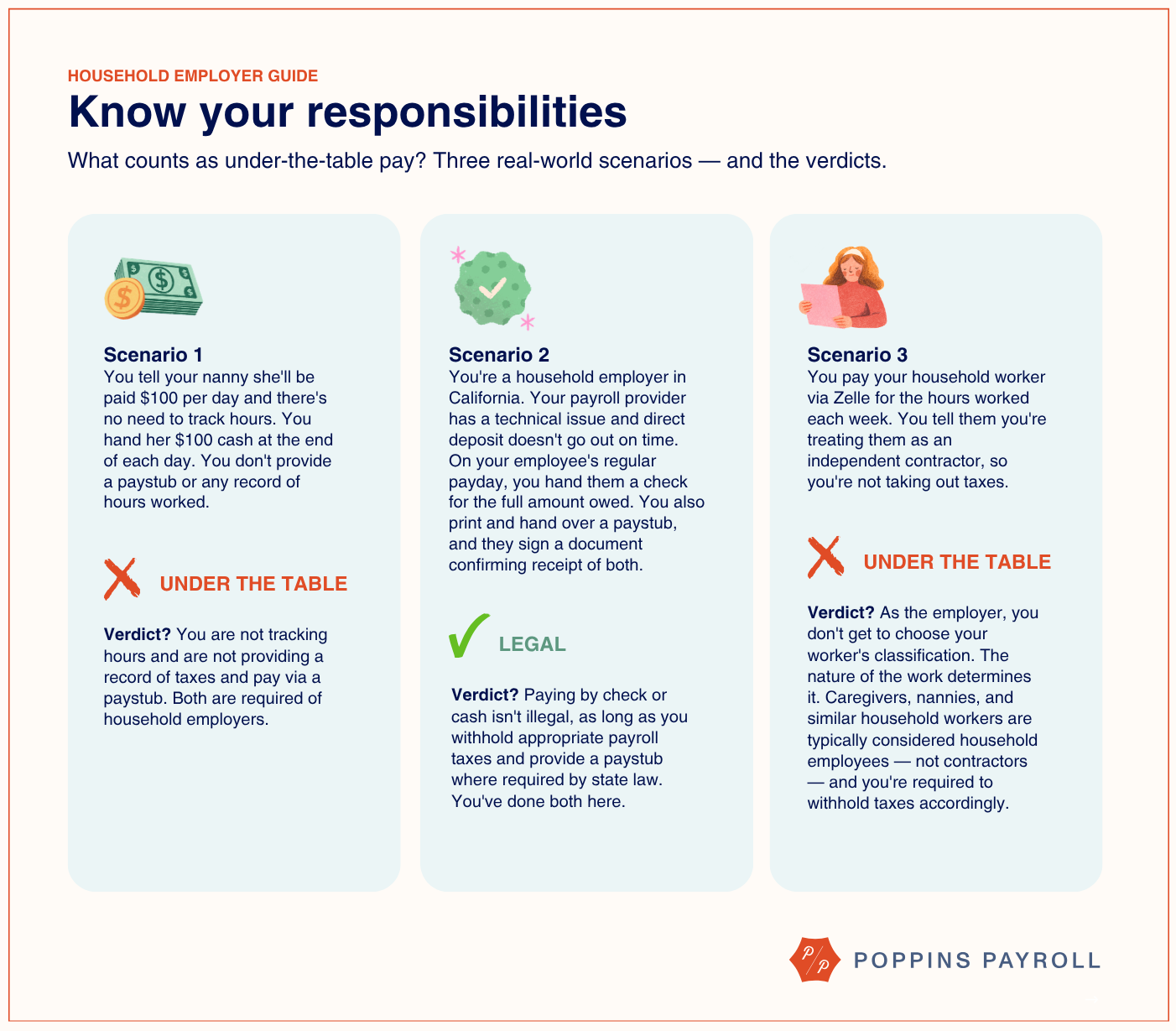
Penalties and legal implications of previous under-the-table payments
If you've been paying a household employee under-the-table, there are potential negative ramifications to be aware of, for both you and your employee.
Penalties for you as the employer
First, it helps to know when employer payroll taxes actually kick in. The IRS sets an annual wage threshold, once you pay a household employee that amount or more in a calendar year, you're required to withhold and pay Social Security and Medicare taxes. If you pay $1,000 or more in any calendar quarter, federal unemployment tax (FUTA) also applies. Paying below these thresholds? You may not owe payroll taxes, but check the current year's figures in the IRS Household Employer's Tax Guide (Publication 926) or confirm with a tax professional.
If you've exceeded those thresholds and paid under the table, the consequences can be significant. You may be subject to back taxes, fines, and legal penalties. These back taxes can include Social Security, Medicare, unemployment contributions, workers' compensation contributions, and more. Plus, you'll likely need to hire a tax professional to help calculate what you owe, an added expense on top of everything else.
Risks for your employee from receiving under-the-table payments
There are also real risks for your employee. If they try to file for unemployment, their claim could be delayed or denied — particularly if their employer hasn't paid into the state unemployment insurance system on their behalf. Long-term, if they haven't been paying into Social Security and Medicare, it could impact their eligibility and payouts in retirement.
If they didn't report their income and pay appropriate taxes, they may be subject to audit and owe back taxes. They may also have trouble accessing loans or other financial products without proof of income. Paying legally protects them, and it protects you, too.
How to catch up on taxes if you paid under-the-table in a previous year
If you've paid under the table in the past, you can still catch up on owed back taxes. It takes a few steps, but it's manageable, and household payroll providers like Poppins can help guide you through the process so you're not navigating it alone.
Step 1: Gather records of your employee's work and pay
Collect any evidence of the employment relationship and payments made. This typically includes proof of payment such as bank transfers, check images, or records from a payment app, as well as any written or electronic communication about schedules, wages, and responsibilities.
Step 2: File amended returns
If you paid an employee under-the-table in a previous year and did not report wages or remit payroll taxes, you may need to file amended returns and pay what you owe. This can include Schedule H (Household Employment Taxes) if you file as an individual, or corrected employment tax returns if applicable. See the IRS Household Employer Guide or speak with a tax advisor, or ask a household payroll provider like Poppins about the payroll compliance side, before filing.
Step 3: Issue corrected wage documentation
Even if you didn't issue a W-2 at the time, you can and should provide one now for any year you paid wages. Consult with a tax professional to issue corrected or late W-2s and ensure your employee's income is properly reported to the IRS.
Can my employee report me for paying under the table?
Yes. Employees who have been paid under-the-table can file a complaint with the Department of Labor, Wage and Hour Division, or with their state's own Department of Labor. Getting ahead of it is always better than waiting for a complaint or audit.
Useful tip: Check out our household employer year-end checklist for everything you need for taxes as a household employer.
Need help catching up? Poppins can walk you through it. Talk to our team
How to protect yourself going forward
If you're ready to pay legally, make sure to take steps to set up your household employment correctly from the start.
Set up proper employment agreements
When you bring on a household employee, have them complete the required forms: Form W-4 (so you know how much federal income tax to withhold) and Form I-9 (to verify they can legally work in the U.S.). You should also have a written employment agreement, see Poppins’ sample nanny contract for reference, in place that documents hours, wages, duties, and any benefits.
Avoid informal arrangements
It can be tempting to keep things casual with a nanny or caregiver, especially if the relationship feels more personal than professional. But informal arrangements, even well-intentioned ones, put both you and your employee at risk. If you catch yourself saying "we'll figure out the paperwork later" or "it's not that much money," that's a sign to pause and get things formalized before work begins.
Work with a payroll or tax professional
Household employment tax rules can be confusing, especially if you've never managed payroll before. A tax professional or household payroll provider can make sure everything is withheld, filed, and handled correctly so you're not left guessing. Poppins specializes in exactly this: we take household payroll off your plate so you can focus on what matters most.
Let Poppins handle the details. Get started in minutes
Pay your nanny or household employee the Poppins way
Poppins Payroll makes it simple to pay your household employee correctly — taxes calculated, filed, and handled for you.
- Easy, on-time payments — Simple setup, straightforward to manage.
- Payroll taxes handled for you — We calculate, withhold, and file eligible federal and state taxes based on current laws
- Year-end forms, covered — W-2s, Schedule H, and more.
Questions? Our team is based in Boulder, CO and just a call away at (855) 420-1919.
Ready to get started? Set up your account today.
Useful resources
- IRS Household Employer’s Tax Guide (Publication 926) — household employer tax rules, wage thresholds, and filing requirements
- Household employer year-end checklist — year-end payroll and tax filing overview
- Sample nanny or caregiver contract — outline wages, duties, schedule, and expectations
- Department of Labor Wage and Hour Division — household employment and worker rights information
This content is for general informational purposes only and does not constitute legal or tax advice. Consult a qualified tax professional or attorney for guidance specific to your situation. Tax laws and thresholds are subject to change.

.png)