
Hiring a caregiver often happens during one of the most stressful seasons a family faces. You're coordinating schedules and managing medical needs all while trying to do right by someone you love. Understanding overtime rules may not feel urgent right now, but getting them wrong can create financial and legal problems at a time when your attention is already stretched thin.
Most families assume overtime works the same way for a caregiver as it does for any other employee: Forty hours and then time-and-a-half kicks in. For most caregivers, that's usually right. But if your caregiver lives with you, works overnight, or pulls 24-hour shifts, the rules get more complicated. Some of those complications are federal. Many of them are specific to your state. This guide breaks down how each type of caregiver is treated and what that means for the hours you're already paying for.
Keep in mind that these rules apply when you hire privately, not through an agency, which has different obligations. (This is because a caregiver hired through an agency is employed by the agency and may qualify as a small business employee. When you directly hire a caregiver, you automatically become a household employer with a different set of rules to follow.)
The federal rule most families start with
The federal government starts with a simple rule: Many privately employed caregivers must receive overtime pay at 1.5 times their regular rate for hours worked over 40 in a workweek. The Department of Labor defines these workers broadly as those providing fellowship, protection, personal care, or health-related services.
The companionship exemption to overtime rules
Most privately-employed caregivers receive overtime after 40 hours. While most families will need to pay overtime, there is one exception that often creates confusion.
The “companionship services exemption” may apply to privately employed caregivers whose primary duties are fellowship and protection. To qualify, personal care services generally cannot exceed 20% of the caregiver’s total working time in a workweek, the caregiver cannot perform medically related tasks (such as administering medication, wound care, or physical therapy exercises) or any general household tasks (such as cooking, cleaning, or laundry) is limited to tasks that primarily benefit the care recipient rather than other household members. Remember that this exemption is relatively rare, because performing any medical tasks, even occasionally, disqualifies the caregiver from this exemption.
How overtime rules differ by caregiver type
What makes overtime laws for homecare workers particularly complicated is the fact that different types of workers have different sets of rules.
There are four main categories of in-home caregivers, each with their own overtime rules:
- Standard shift caregivers who work regular daytime hours and live in their own home
- Overnight caregivers who work extended overnight shifts (typically 8-24 hours) and live in their own home
- 24-hour shift caregivers who work full 24-hour shifts but live in their own home
- Live-in caregivers who reside in the care recipient's home on a permanent or extended basis
For standard shift caregivers (generally non-exempt employees), federal overtime rules apply straightforwardly: overtime after 40 hours per week. The sections below focus on the three types where the rules get more complicated.
Do live-in caregivers get overtime?
According to the Department of Labor, a live-in caregiver is defined as “an employee who provides domestic services in a private home and resides on his or her employer’s premises on a ‘permanent basis’ or for ‘extended periods of time,’’ with an extended period of time defined as five days or 120 hours consecutively.
At the federal level, live-in caregivers are exempt from receiving overtime based on the “live-in domestic service employee exemption.” This is an exemption that is only available to individuals or families that hire a caregiver privately, not to agencies. Note that many states have stricter rules that override this exemption and rules vary by state, so check the rules in your area before assuming your live-in caregiver is exempt. Consult an employment attorney if you're unsure whether this exemption applies to your situation.
Do 24-hour shift caregivers get overtime?
24-hour shift caregivers are those that work a full 24-hour shift, but still reside in their own home. Typically, these caregivers are subject to overtime rules at the federal level, meaning they get overtime pay for any hours worked over 40 in a workweek.
It is important to calculate hours worked correctly for this type of caregiver. You need to accurately record their hours worked, minus breaks (times they are completely relieved from duty) and sleep time. Sleep time has some specific rules to follow, and generally it can be up to 8 hours, but must be at least 5 hours of uninterrupted, consecutive time.
Do overnight caregivers get overtime?
In most cases, overnight caregivers are non-exempt employees and are entitled to overtime pay when they exceed applicable federal or state overtime thresholds. Overnight caregivers work an overnight shift, often greater than 8 hours, but less than 24 hours. Just like a 24-hour shift, you must ensure you are calculating working hours with breaks and meal times correctly. Sleep time cannot be excluded for workers with shifts less than 24 hours.
Why your state's overtime rules may change what you owe
Even after you've identified your caregiver type, there's another wrinkle: Some states calculate overtime differently than the federal government does. Understanding the difference between daily and weekly thresholds will help you make sense of the state rules below.
One area of regulation to pay close attention to is daily and weekly overtime thresholds. These come into play in certain states’ specific overtime rules.
- A daily overtime threshold means overtime kicks in after a set number of hours in a single day, regardless of total weekly hours. California is the primary example: certain household caregivers, such as personal attendants, may be entitled to overtime if they work more than 9 hours in a day or over 45 hours in a workweek, even if federal overtime would not otherwise apply. Nevada follows a similar daily threshold (over 8 hours/day). Most other states don't have a daily threshold at all.
- A weekly overtime threshold means overtime kicks in after a set number of hours in a 7-day workweek. This is how the federal rule works, and how most states operate. Federal law sets the weekly threshold at 40 hours. Some states set it higher for live-in caregivers (New York and Oregon: 44 hours; Minnesota: 48 hours) or leave it at 40.
When a state has both a daily and a weekly threshold, you owe overtime based on whichever calculation results in more pay for the caregiver.
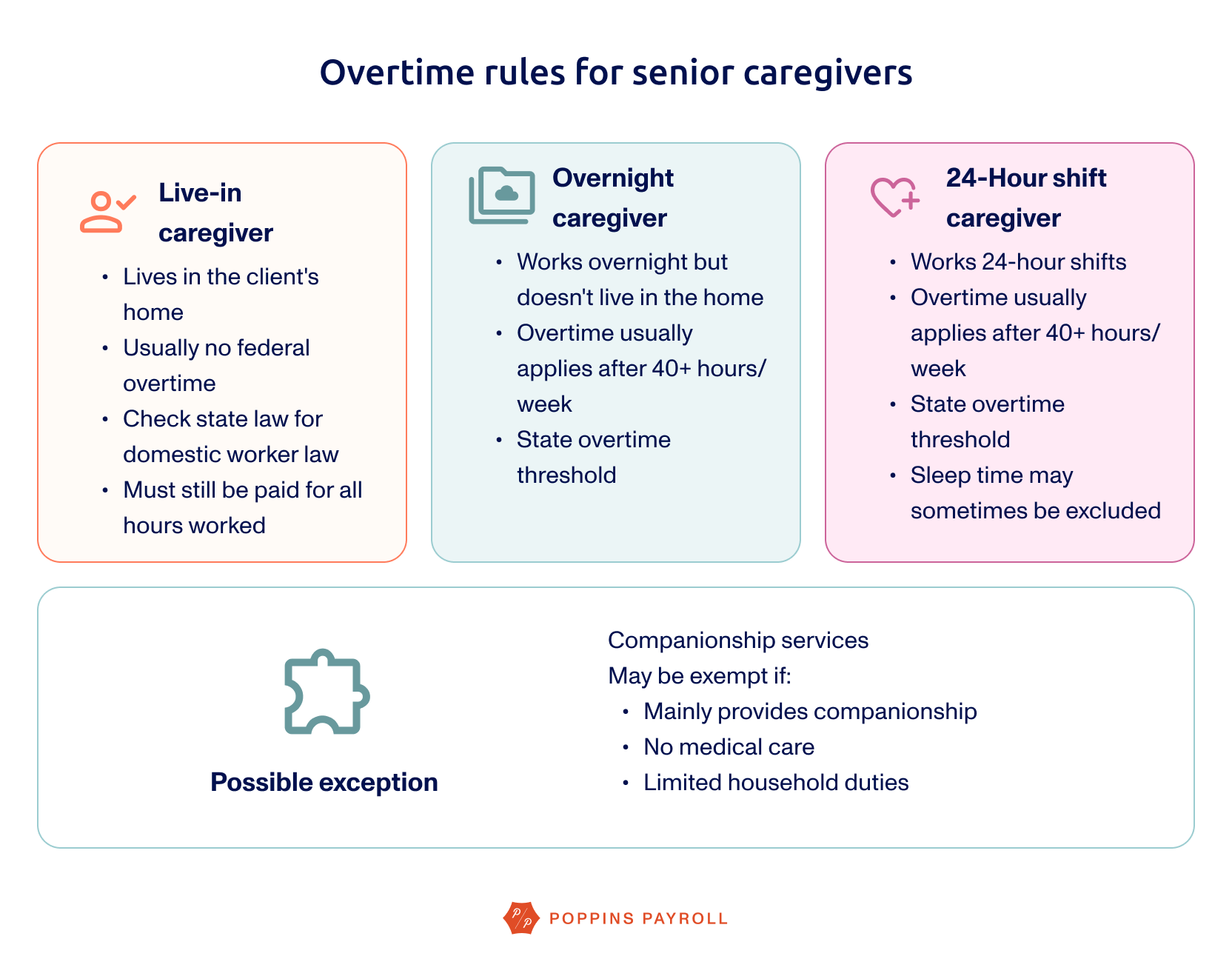
Overtime rules for senior caregivers: Quick guide
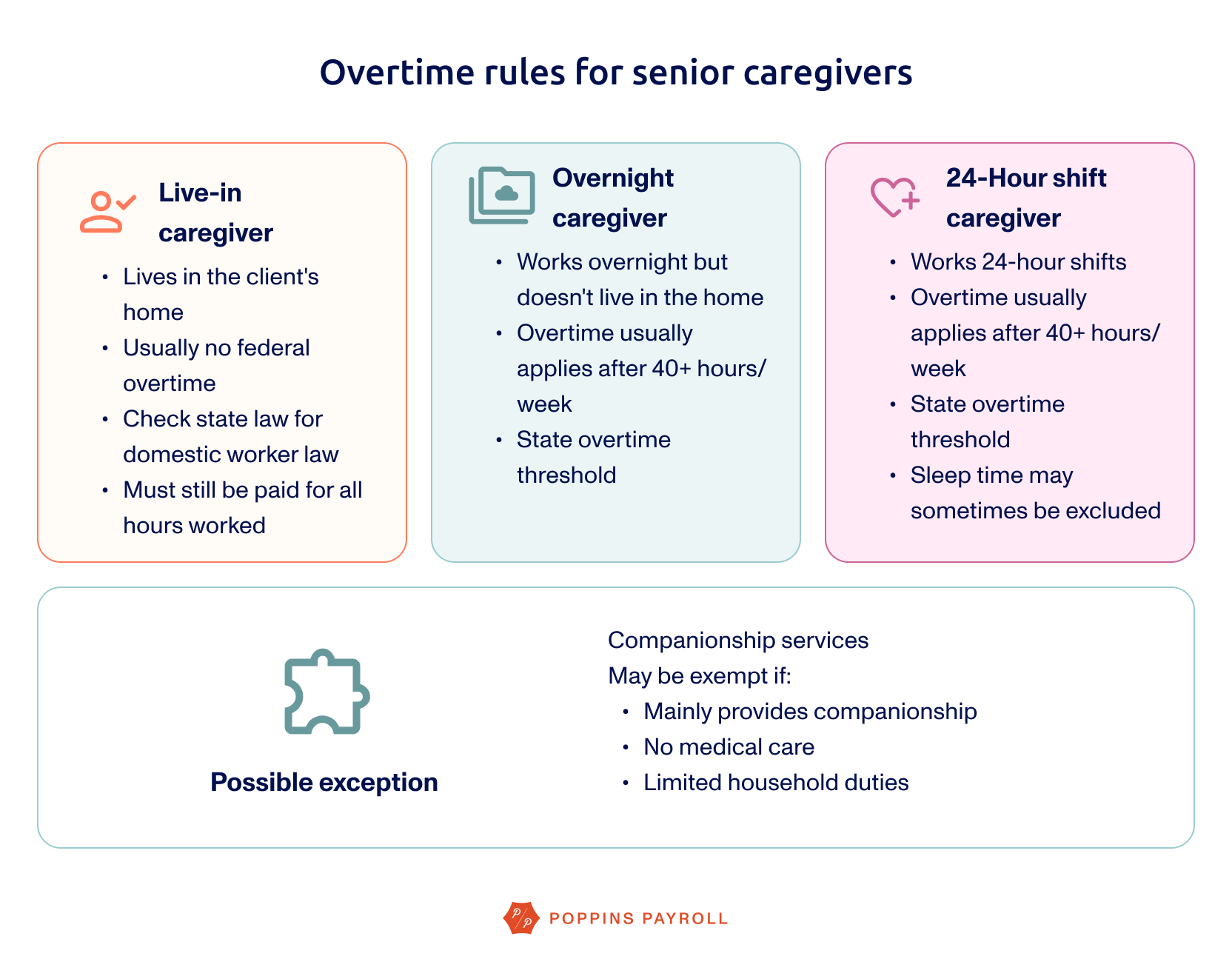
1. Live-in caregiver
Lives in the client's home
Federal rule
- No overtime required under federal law
- Must still be paid for all hours worked
Important
Even though federal law exempts live-in caregivers from overtime, several states have passed their own domestic worker laws that remove this exemption entirely. In California, Massachusetts, New Jersey, and New York, live-in caregivers are entitled to overtime pay under state law, regardless of what the federal rule says. When state law provides greater protections than federal law, the state rule applies. See the state-by-state table below for specifics.
2. Overnight caregiver
Works overnight but does not live in the home
Overtime applies when:
- Hours worked exceed 40 per week*
- State overtime thresholds are exceeded
* State laws may set different thresholds or provide greater protections than federal law.
Important
- Overnight hours generally count as work time
- Sleep time usually cannot be excluded for shifts under 24 hours
3. 24-Hour shift caregiver
Works 24-hour shifts but does not reside in the home
Overtime applies when:
- Hours worked exceed 40 per week*
- State overtime thresholds are exceeded
Important
- Some sleep and meal periods may be excluded if legal requirements are met
- Interrupted sleep may count as paid work time
Possible exception
Companionship Services Exemption
May be exempt from overtime if:
- Fellowship and protection are the primary duties
- No medical care is provided
- General household work is limited to tasks that primarily benefit the care recipient
A state-by-state guide to overtime rules
The same caregiving schedule can produce very different overtime obligations depending on where you live. Families who assume the federal rules always apply can unintentionally underpay a caregiver.
Here are some of the states with overtime requirements that go beyond the federal baseline.
For more state-specific information, check out our household employee state resources guide. State laws change frequently. Confirm current rules with your state labor agency or an employment attorney before making payroll decisions.
Common overtime mistakes to avoid
Even families who are paying attention to this stuff can end up miscalculating. Here are the four mistakes that come up most often.
- Treating live-in caregivers as automatically exempt
- Federally, they may be overtime exempt. But some states don't allow that exemption. - Miscounting hours worked
- Sleep time and meal periods don't always count the way families assume. - Applying only federal rules
- State laws can require additional overtime. Make sure you check the rules in your state so you can follow them accordingly. - Paying a flat weekly rate
- Without tracking hours, it's easy to miss overtime obligations.
The good news is that you don't have to become an employment law expert overnight. You just need to know which rules apply to your caregiver and have a reliable system for tracking hours and calculating pay correctly. As a household employer, it's worth familiarizing yourself with these rules and the other requirements that come with the role.
Caring for a parent is hard enough without needing to become fluent in overnight exclusions and state-specific rules. Poppins calculates overtime automatically based on the hours you enter, so the math is handled and you can focus on the person who needs you. It only takes about 10 minutes to get started.
Useful Resources
- U.S. Department of Labor Home Care Rule – federal overtime requirements for home care workers
- IRS Household Employer's Tax Guide (Publication 926) – household employer payroll and tax responsibilities
- Fact Sheet #25: Home Health Care and the Companionship Services Exemption Under the Fair Labor Standards Act (FLSA) – verify state-specific overtime rules and exemptions
- Fact Sheet #79B: Live-in Domestic Service Workers Under the Fair Labor Standards Act (FLSA) – payroll, wage, and tax compliance basics
- Household Employee State Resources Guide – state-by-state household employment requirements
The information in this article is for general educational purposes only and does not constitute legal or tax advice. Overtime rules vary by state and are subject to change. Consult a qualified employment attorney or tax professional for guidance specific to your situation.