
Hiring a caregiver for an aging parent is uniquely challenging. You're not just filling a role. You're inviting someone into your parent's home, into their daily routines, and into some of the most intimate moments of their life. They'll be there for bathing, dressing, the harder parts of the day. That kind of closeness takes real trust.
Sometimes you're making this decision after a scary event: a fall, a diagnosis, a surgery that changed things fast. Other times you've been watching a gradual decline for months, or a spouse who has been managing care on their own has reached a point where they need help. Or maybe you've noticed your parent is no longer safe to be left alone, and the conversation you've been putting off can't wait any longer.
Whatever brought you here, the interview is where you figure out if this person is right for your family. Good caregiver interview questions don't just screen for credentials. They reveal whether a caregiver listens, whether they'll adapt to how your family does things, and whether your parent will actually feel comfortable around them. That last part matters more than most families expect. Because of how intimate this role is, your parent's comfort with the caregiver and their sense of ease and trust is often more important than any certification. The right questions also surface red flags before day one, not after.
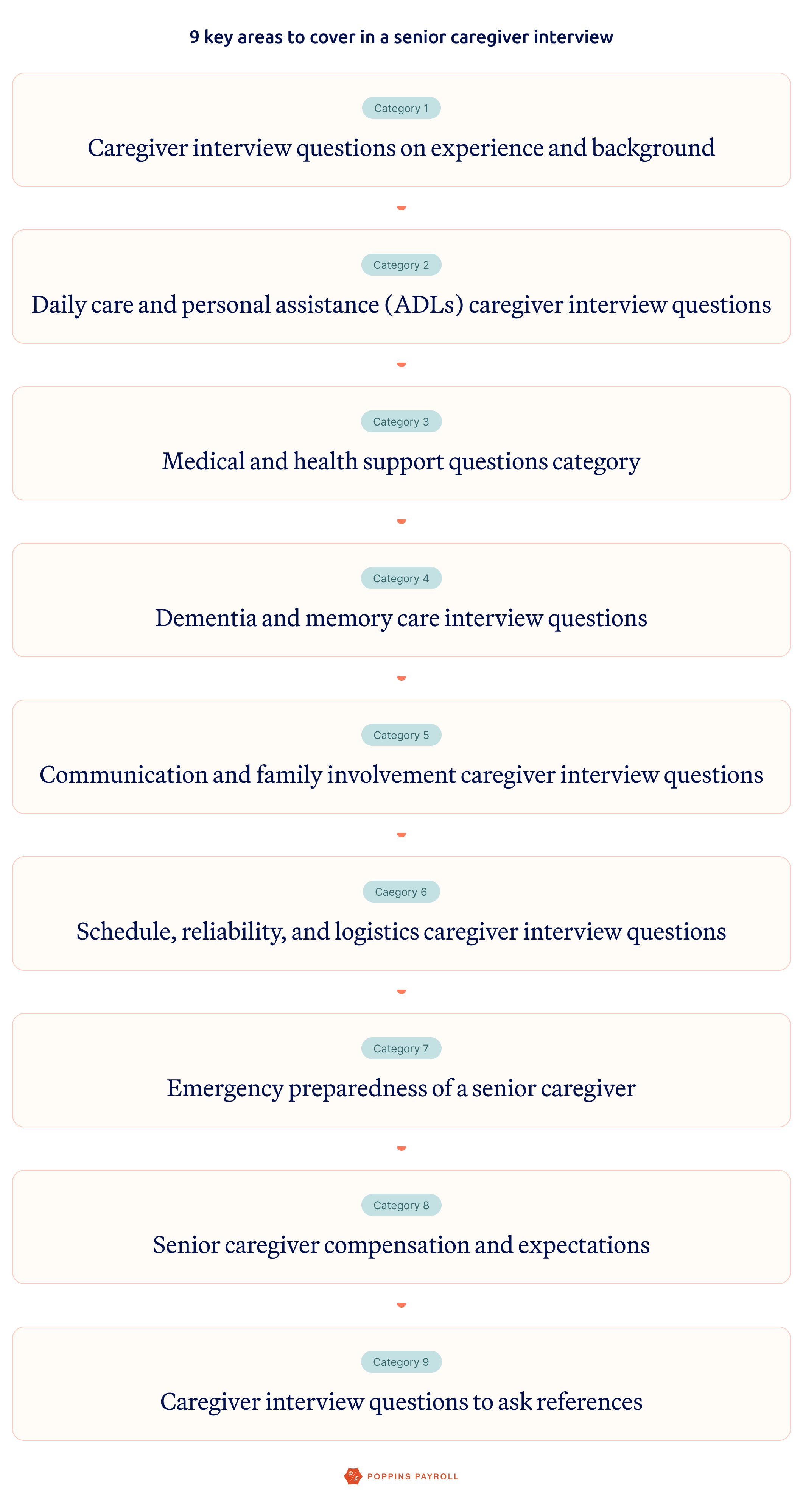
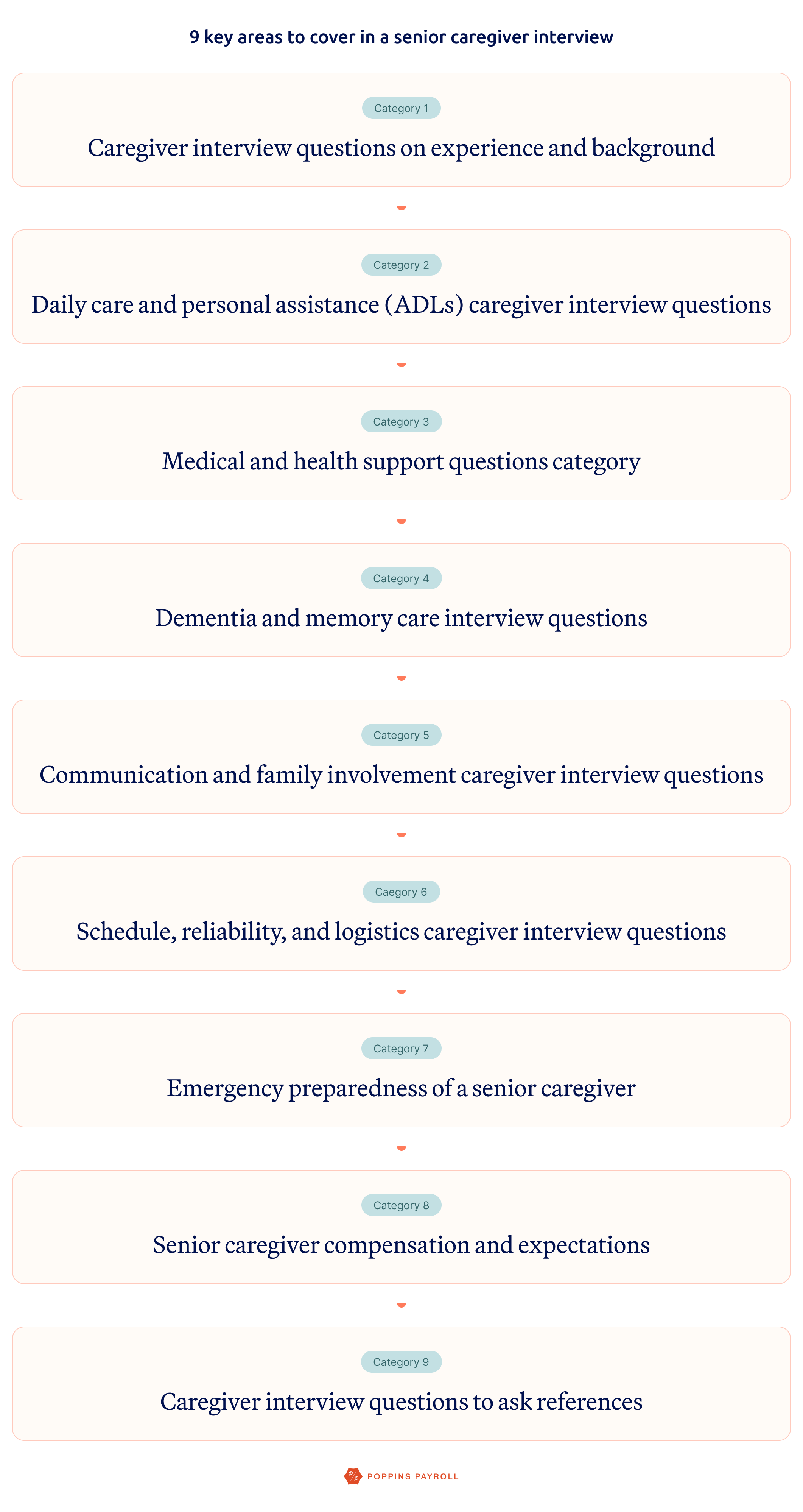
Below are 45+ senior caregiver interview questions organized across nine categories, from experience and daily care to emergency preparedness and compensation. But before you dive in, there's one step worth doing first.
Before you start a senior caregiver interview: know what you're looking for
Not every family needs the same caregiver. Before you schedule a single interview, it's worth spending a few minutes being honest with yourself about what matters most — because the answer shapes every caregiver interview question you'll ask.
Here are three common caregiver profiles families look for. They're meaningfully different, and someone who's a great fit for one may not be right for another.
The warm companion. Your parent is relatively independent but lonely, or needs light help around the house. What matters most is personality: someone patient, kind, easy to be around, and ideally someone who shares a language, a background, or interests with your parent. Clinical experience matters much less than genuine warmth and the ability to connect. If this is your situation, lean heavily on caregiver interview questions about communication style, daily routines, and how they build rapport. Skip or de-emphasize the medical and dementia sections.
The medically experienced caregiver. Your parent has complex needs — advanced dementia, Parkinson's, post-surgical recovery, or conditions requiring careful health monitoring. Here, credentials, training, and specific clinical experience are non-negotiable. You'll want to scrutinize certifications, dig into their experience with the specific condition, and ask detailed caregiver interview questions about medication reminders, escalation protocols, and emergency response. The warmth questions still matter, but they come after you've confirmed the clinical fit.
The flexible generalist. Your parent needs real help with daily tasks — bathing, dressing, meals, mobility — but doesn't have a condition that requires specialized clinical training. What you're looking for is reliability, adaptability, and someone who will do things the way your family wants them done, not the way they've always done it at previous jobs. Ask about how they've adjusted to different households, how they handle feedback, and whether they're comfortable taking direction on routines and preferences.
One question worth sitting with before any caregiver interview: does my parent have a preference? A caregiver who speaks their first language, shares their cultural background, or has a personality that clicks with theirs can make an enormous difference in how well the arrangement actually works, regardless of what the resume says.
Once you know what profile you're hiring for, use the categories below as a guide. You don't need to ask all of these caregiver interview questions. Pull the sections that are most relevant to your situation and skip what isn't. Someone interviewing a companion doesn't need the dementia questions. Someone hiring for complex medical care should spend much more time on sections 3 and 4 than section 1.
45+ senior caregiver interview questions
1. Caregiver interview questions on experience and background
Understanding the depth and type of experience a caregiver has is a starting point, but how much it matters depends entirely on what you've decided you need. For a companion role, four years of warm, reliable experience with elderly clients may outweigh a certification. For a medically complex situation, the opposite is true.
- How long have you been working as a caregiver, and what types of clients have you primarily worked with?
- Have you cared for someone with [your parent's specific condition: dementia, Parkinson's, post-surgical recovery, etc.]? What did that care look like day to day?
- What formal training or certifications do you have: CNA, HHA, CPR/First Aid? Are any of them current?
- Why did you choose elder care work? What keeps you in it?
- What's the most challenging caregiving situation you've handled, and how did you navigate it?
- Have you ever cared for someone at end of life? How did you approach that?
2. Daily care and personal assistance (ADLs) caregiver interview questions
Activities of daily living — bathing, dressing, grooming, toileting — are often where families feel most uncertain asking questions. Ask anyway. A strong caregiver will answer directly and without discomfort.
- How do you approach helping someone with bathing and personal hygiene, particularly someone who may feel embarrassed or resistant?
- Are you experienced with mobility aids such as walkers, wheelchairs, Hoyer lifts? Have you done bed-to-chair transfers?
- How do you think about preserving a person's independence and dignity during personal care tasks?
- What's your approach when a client can still do something themselves, but it takes much longer than if you just did it for them?
- Have you worked with clients with incontinence? How do you handle that with sensitivity?
3. Medical and health support questions category
This is where the medication question comes up. It's worth being precise about. There's a meaningful difference between medication reminders (a caregiver's role) and medication administration (a licensed nurse's role). Most private in-home caregivers are not authorized to administer medications, and a good caregiver will know that distinction without prompting.
- What's your experience with medication reminders? Can you walk me through how you'd track and document those?
- Are you trained to administer medications, or do you provide reminders only? [Note: most non-medical caregivers provide reminders only. If a candidate claims to administer medications, verify their credentials and confirm what your state permits, as requirements vary.]
- Have you worked with clients managing [specific conditions: diabetes, heart disease, COPD, Parkinson's]? What did that involve?
- How do you monitor for changes in a client's health or behavior? What would prompt you to call the family or a doctor?
- What do you do if a client refuses to take their medication?
4. Dementia and memory care interview questions
Not every family needs dementia-specific care today, but many eventually do. If memory loss or cognitive decline is already part of your parent's situation, these questions can help you evaluate whether a caregiver has the specialized skills the role requires.
- Have you cared for someone with Alzheimer's or dementia? What stage were they in?
- When a client with dementia becomes confused or agitated, what's your approach?
- How do you redirect someone who is fixated on something distressing?
- What do you do when a client refuses care: refuses to bathe, get dressed, or eat?
- Have you experienced a client who sundowns or becomes difficult in the evenings? How did you manage that?
- How do you handle it if a client with dementia says something hurtful or accuses you of something untrue?
5. Communication and family involvement caregiver interview questions
Even the most skilled caregiver won't be the right fit if communication breaks down. Understanding how a caregiver keeps families informed can prevent misunderstandings and help everyone stay aligned.
- How do you keep families updated on how things are going day to day? Do you use a daily log, texts, calls?
- If you noticed something concerning — a new bruise, a change in mood, a refusal to eat — how would you handle that?
- Have you ever disagreed with a family about how to care for a client? How did you handle it?
- Are you comfortable working alongside a care manager, home health agency, or other medical professionals involved in a client's care?
- How do you handle it if the care recipient asks you to keep something from the family?
6. Schedule, reliability, and logistics caregiver interview questions
Backup coverage is one of the biggest practical vulnerabilities in private caregiving. Unlike an agency, there's no automatic substitute if your caregiver calls in sick, so ask about it directly.
- What does your typical availability look like? Are you available for the schedule we're considering?
- What happens if you're sick or have an emergency? Do you have someone you'd recommend as backup coverage?
- Do you have a valid driver's license? Are you comfortable transporting my parent to appointments? [If relevant to your situation.]
- Do you prefer live-in or live-out arrangements? [If relevant to your situation.]
- How much notice do you need for schedule changes, and how do you prefer we communicate about logistics?
7. Emergency preparedness of a senior caregiver
Most caregiving days are routine. The challenge is knowing how someone responds when they aren't.
- Is your CPR and First Aid certification current? When did you last complete a refresher?
- What would you do if my parent fell and couldn't get up?
- Have you ever had to call 911 for a client? Walk me through what happened.
- What would you do if you noticed signs of a stroke: facial drooping, arm weakness, slurred speech?
- Do you feel comfortable with an emergency evacuation plan if there were a fire or natural disaster?
8. Senior caregiver compensation and expectations
Once you're confident a caregiver can provide the level of care your parent needs, it's time to discuss the practical details of working together. Covering compensation in the interview sets a professional tone and prevents misunderstandings later. It also opens the door to talking about the formal employment arrangement, something many families don't think to raise until problems come up.
- Does the hourly rate we've discussed feel fair to you? Are there any aspects of the compensation you'd like to talk through?
- What are your expectations around paid time off, holidays, and sick days?
- If you drive my parent to appointments, how do you prefer to handle mileage reimbursement?
- Are you comfortable being paid through a formal household payroll arrangement with proper withholding and a W-2 at year-end?
When you hire a private caregiver and pay them $3,000 or more in a calendar year or $1,000 in a quarter, you become a household employer, and that comes with payroll and tax obligations most families don't anticipate. (Requirements subject to annual adjustment; see IRS Publication 926).
Poppins handles the payroll side for elder care families, including tax withholding, W-2s, and filings, so you can focus on finding the right person. Learn more at our senior care employees page.
9. Caregiver interview questions to ask references
A strong reference check is as important as the interview itself. Once you've narrowed your candidates, contact at least two or three previous families directly. Ask open-ended questions and listen for specificity — the best references describe actual situations, not just general impressions.
- How long did the caregiver work with your family?
- What did they do particularly well?
- Were they reliable and punctual?
- How did they handle difficult situations?
- Would you hire them again?
If a reference is hard to reach, gives only vague answers, or seems overly scripted, treat that as a signal worth taking seriously. For more guidance on what to look for, AARP's caregiving resource center has additional information on evaluating and vetting in-home care candidates.
Questions you should not ask during a senior caregiver interview
Federal, state, and local fair-hiring laws may restrict the questions employers can ask or use when making hiring decisions. State and local protections vary, so household employers should avoid questions unrelated to a candidate’s ability to perform the job. Avoid any questions about:
- Age or date of birth
- Health conditions, disabilities, or medical history
- Religion or religious practices
- National origin, citizenship status, or place of birth (you can ask if they're legally authorized to work in the U.S.)
- Family status, marital status, or whether they have children
- Political beliefs
These questions don't just create legal exposure — they can also discourage strong candidates from moving forward. If you're also looking for guidance on nanny interviews, the same principles apply: see our nanny interview questions guide for a parallel reference.
Red flags to watch for
Even with the right caregiver interview questions, how a candidate answers them matters as much as what they say.
- Vague or evasive answers about difficult situations. Caregiving is hard. Anyone who's done it well has a specific story. If a candidate can't describe a challenging situation with any detail, that's worth noting.
- Dismissiveness about client dignity or autonomy. Listen for language that suggests the caregiver views the client as a problem to manage rather than a person to support. "They just need to follow the routine" or "I don't let them get away with that" are warning signs.
- A rigid approach to how things get done. A good caregiver adapts to your family's routines and preferences, not the other way around. If someone seems wedded to doing things a particular way and isn't curious about how your household works, pay attention to that.
- Cash-only insistence. A caregiver who is unwilling to be paid through a documented arrangement may have reasons for avoiding tax records or may simply not understand that household employment has legal obligations attached. Either way, it's worth a direct conversation before moving forward.
- Unwillingness to involve family or medical professionals. Good caregivers understand they're part of a team. Reluctance to communicate or defer to family on important decisions is a red flag.
- No current certifications, especially for complex care. For a client with dementia, Parkinson's, or significant mobility challenges, credentials aren't just a formality. A caregiver who hasn't kept up with training may not be equipped for what the role requires.
- Negative talk about former clients or families. What they say about past employers tells you a lot about how they'll speak about you.
Tip: Save this page or print the questions that are most relevant to your parent's situation before your interviews. You don't need to ask every question — focus on the categories that matter most for the care you're arranging.
Once you've found the right person
The interview is only part of the hiring process. Before your senior caregiver starts, verify references, run a background check, and confirm any certifications they've mentioned. If you use a third-party background screening service, federal, state, and local notice and authorization requirements may apply.
You'll also need to think through the employment side. When you hire a private caregiver directly, you become a household employer, which means payroll taxes, proper documentation, and a W-2 at year-end. You will also generally need to complete Form I-9 to verify identity and employment authorization. Most families don't expect that step, but it's straightforward once you have the right setup in place.
Poppins handles household payroll for elder care families, including tax filings, W-2s, and the paperwork that comes with becoming an employer. If you're hiring a caregiver who works alongside a nanny or other household help, you can manage all of it in one place.
Useful resources for families hiring a sdenior caregiver
Official U.S. government service that helps families find local aging services, caregiver support programs, and Area Agencies on Aging.
Practical guides on hiring caregivers, evaluating in-home care options, and supporting aging loved ones.
Evidence-based information on aging, caregiving, Alzheimer's disease, and long-term care planning.
Resources for families hiring caregivers for individuals living with Alzheimer's disease or other forms of dementia.
Guidance on household employment, caregiver payroll, tax withholding, and W-2 requirements for families hiring caregivers directly.
Overview of Medicare-covered home health services and eligibility requirements.
The content of this article is general and informational in nature and may not be appropriate for your specific circumstances. It is not intended to provide legal or tax advice and should not be relied upon without consulting with an attorney and/or tax professional.
.png)