
You just found out your parent has dementia. There's no ER discharge summary, no checklist someone hands you on the way out the door. Figuring out what to do after a dementia diagnosis is rarely obvious. You likely have more time than you'd have after a fall or a stroke, but that time doesn't mean much without a sense of what actually needs your attention first.
Most of this doesn't have to fall on one person alone. If you have siblings, or if your other parent is in the picture, getting everyone roughly aligned early tends to save a lot of friction later, especially once legal decisions are on the table.
Here's what to do after dementia diagnosis, how to care for a parent with dementia, what to prioritize in the first few months, and what can reasonably wait until you have more information.
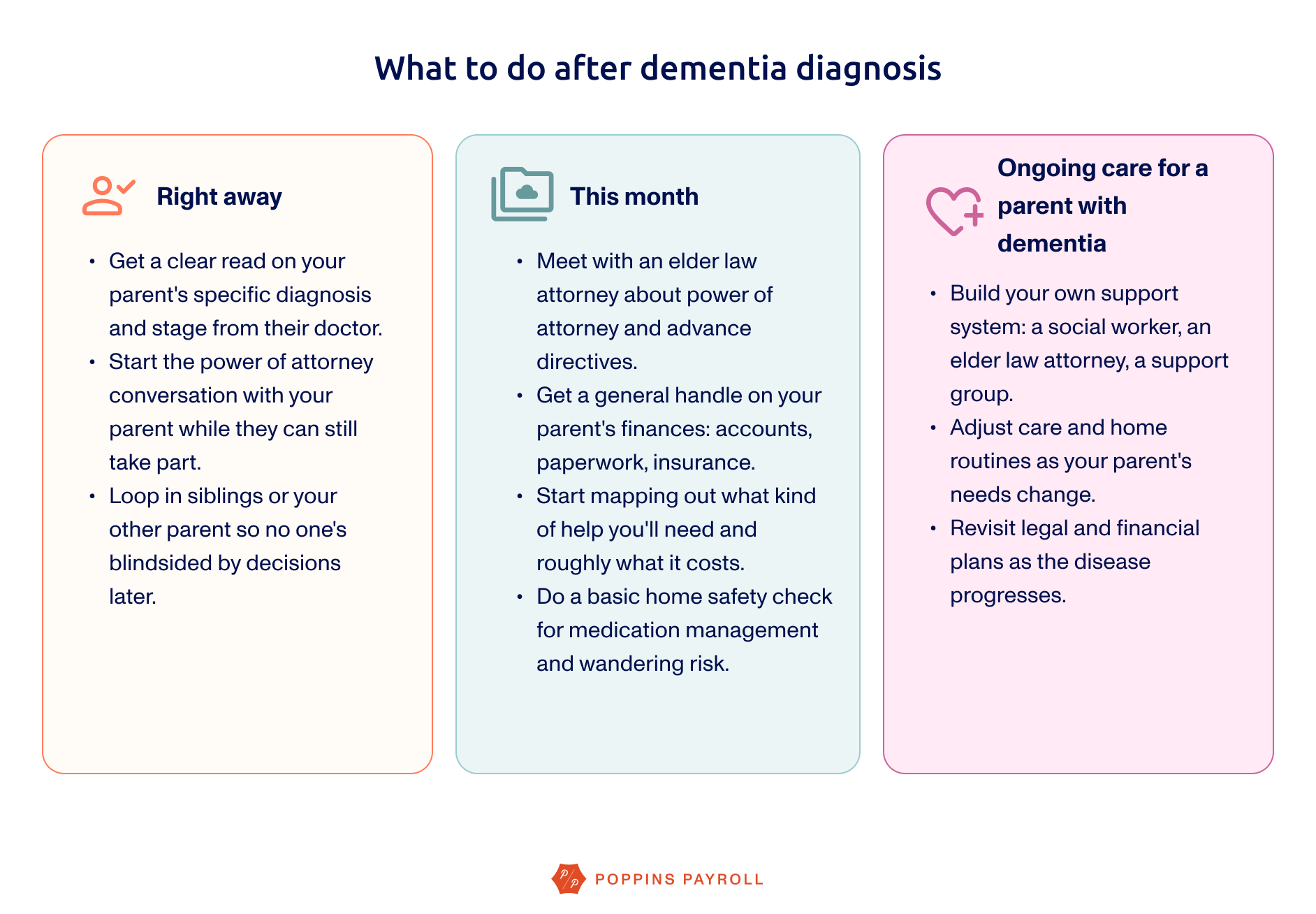
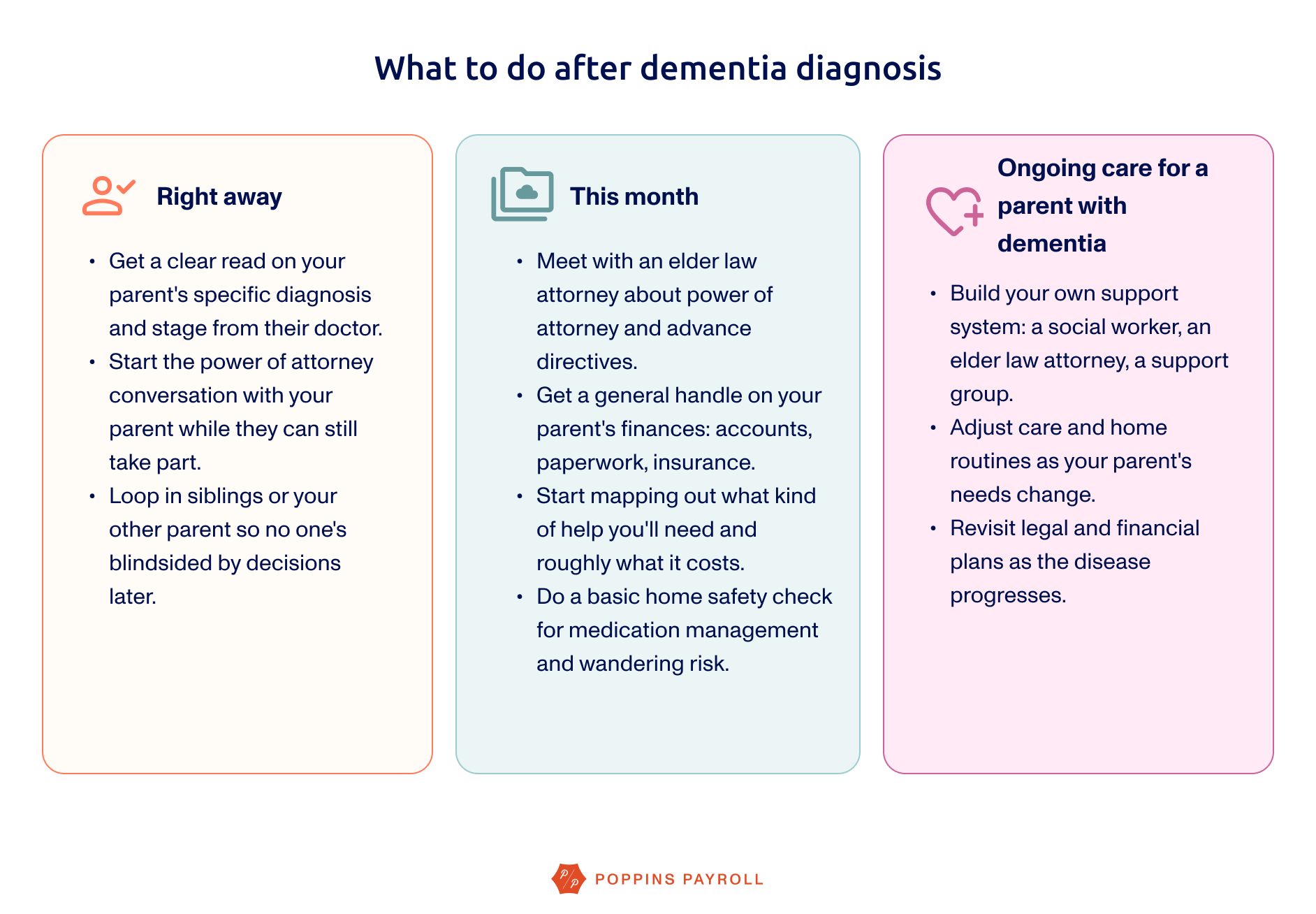
What to do after dementia diagnosis: Your first few months, at a glance
Some of this needs attention right away. Most of it can happen over the following weeks and months, at a pace your family can manage.
Understand what the dementia diagnosis means
The World Health Organization describes dementia as a condition that “affects memory, thinking and the ability to perform daily activities” – but for a parent with dementia, that clinical definition rarely captures what the day-to-day actually looks like.
Dementia doesn’t follow a single timeline. Alzheimer's, vascular dementia, Lewy body dementia, and frontotemporal dementia all progress differently, and even within the same diagnosis, the pace varies enormously from person to person. Your parent's neurologist or geriatrician is the best source for what their specific dementia diagnosis means, so ask what stage they believe your parent is in and what changes tend to come next for that particular type.
Broadly, people talk about early, middle, and late dementia stages, though these aren't a fixed timeline. Plenty of families describe a parent who's stable for years before things change quickly, or the reverse.
It’s important to acknowledge that the onset of dementia is a loss, even though your parent is still here. Researchers who study caregiving describe a real grieving process that starts well before end of life, as your parent's personality and memory gradually change. Feeling that grief doesn't mean you're overreacting.
Your parent may be feeling something similar, sometimes more acutely: fear, denial, or resistance to being "handled" by their own kids. Pushback in these early conversations often isn't a refusal to plan. It's closer to grief showing up as defensiveness, and it tends to soften once your parent feels like a participant in decisions rather than a subject of them.
Organizations like the Alzheimer's Association and the National Institute on Aging both have plain-language guides on what to expect at each stage.
Start the legal and financial groundwork with your parent
This is the biggest way a dementia diagnosis differs from a fall or a stroke. You likely have time to do this properly instead of scrambling through it during a crisis.
The most urgent piece is power of attorney, both financial and medical. For a power of attorney to hold up, your parent has to be considered competent at the time they sign it, which is exactly why this can't wait for "someday." If you put it off until your parent's judgment has declined further, you may be looking at a court-supervised guardianship process instead, which is slower, more expensive, and harder on everyone. An elder law attorney can walk you through what's needed in your state, and can also help set up an advance directive so your parent's medical wishes are documented while they can still express them clearly.
Get everyone roughly on the same page. If you have siblings, or if your other parent is still involved, decide early who's actually going to hold power of attorney and how much everyone needs to agree before acting. You can name co-agents who act together, name one person with everyone else looped in, or name successors in case your first choice can't serve.
Note that not everyone processes a parent's dementia diagnosis at the same pace, and one sibling pushing to act quickly while another isn't ready is closer to the norm than the exception. Agreeing on a regular check-in tends to prevent bigger conflicts down the road.
While you're meeting with an attorney, it's a good time to get a general handle on your parent's finances. You don't need to solve anything yet but it’ll be helpful for the future to know where things stand, like:
- What accounts exist, and where the paperwork lives
- Whether there's long-term care insurance
- Roughly what their monthly income and expenses look like
Some families also plan for a family member to be paid as a caregiver, often as part of Medicaid planning. That comes with its own rules and timing, and The Medicaid Lookback and Your Family Caregiver covers what to know once you're at that stage.
Caring for a parent with dementia: Figure out what kind of help you'll need, and when
Most families don't go from zero help to full-time care overnight. It usually starts smaller: someone to check in a few times a week, help with errands, or keep your parent company so they're not isolated. That can look very different from the more hands-on personal care that tends to come later, and it's worth thinking about both now so you're not caught flat-footed when needs shift.
One decision that comes up early is agency versus private hire. Agencies handle the vetting and scheduling for you, which matters when you're already stretched thin, but families who've moved from an agency to a private hire often describe a wide gap between what they're charged and what the caregiver actually takes home. Private hiring can mean better pay for the caregiver and more control over who's coming into your parent's home, but it puts the employment logistics on you: contracts, scheduling, and legal payroll if the caregiver is a household employee rather than an independent contractor.
Cost is part of this conversation, and it's reasonable to start mapping out roughly what a few hours a week of help would cost in your area, and to revisit that number as care needs grow.
For a deeper look at vetting and hiring a caregiver directly, How to Hire a Trustworthy Independent Private-Pay Caregiver covers what to ask, what a fair contract looks like, and how to think about pay.
Prepare the home and routines for how daily life for a parent with dementia will change
Dementia-proofing a home looks different from fall-proofing one.
Grab bars and better lighting still matter, but the bigger priorities here are managing wandering risk, staying on top of medications, and cutting down the decisions and distractions your parent has to handle alone. The Alzheimer's Association's home safety guidance is a solid starting checklist, and many local senior services agencies will do an in-home safety walkthrough for free.
Driving is one of the hardest home-safety conversations to have because it’s about your parent’s independence. Taking it away can feel like confirming the diagnosis in a way nothing else does. Raise it early, while your parent can still be part of the decision, rather than waiting for a near-miss to force the issue. A doctor can sometimes make it easier by framing it as a medical recommendation rather than a family judgment call, and many states offer a formal driving evaluation that can settle the question with less conflict than a family debate.
Routine matters more than most families expect. Consistent mealtimes, a predictable daily rhythm, and familiar surroundings can reduce agitation and confusion. Established routines especially help in instances of sundowning, a pattern of late-day confusion and restlessness that shows up for many people with mid-late stage dementia as evening approaches.
Build your own support in advance
Here's something a lot of families say only after the fact: they wished they'd had one person who could walk them through the whole thing, someone who already knew the landscape and could tell them what mattered this month versus what could wait. If that person doesn't exist yet in your life, this is the moment to start building toward it, whether that's a social worker through your local Area Agency on Aging, an elder law attorney, or a caregiver support group.
Consider support groups in particular for ground-level advice. Caregivers who attend them regularly describe them as the place they hear the practical, unglamorous details that don't show up in official guides: which local agencies are worth calling, how other families handled a specific insurance headache, what actually helped when a parent started resisting help. The Family Caregiver Alliance and AARP's caregiving resources both maintain directories to help you find one nearby or online.
You don't need all of this figured out today. Legal groundwork, care planning, home changes, and your own support system can happen in parallel, at whatever pace your family can manage.
When you're ready for paid help
Everything covered here, the legal groundwork, the care for a parent with dementia planning, the home changes, takes time and energy.
At some point, many families reach a stage where a parent needs more support than one person can reasonably provide alone. Once you're paying someone to help, whether a private caregiver or an agency worker, Poppins handles the household payroll and tax side: registering with the state, calculating withholdings, and filing taxes, so that part isn't one more thing on your plate.
See how Poppins works for elder care families.
Useful resources
Official & research
Caregiver support & guidance
- Alzheimer’s Association
- Alzheimer’s Association: home safety guidance
- Alzheimer’s Association: dementia and driving
- Family Caregiver Alliance
- AARP caregiving resources
From Poppins Payroll


.png)