Hire a nanny or senior caregiver, and you take on a job nobody mentions: payroll tax filer. Here's the part that trips almost everyone up: The timing isn't intuitive. Federal, state, and (depending on where you live) monthly or annual filings each run on their own schedule, and they rarely line up the way you'd expect.
Here's how household employment tax deadlines actually work.
Household employment tax deadlines at a glance
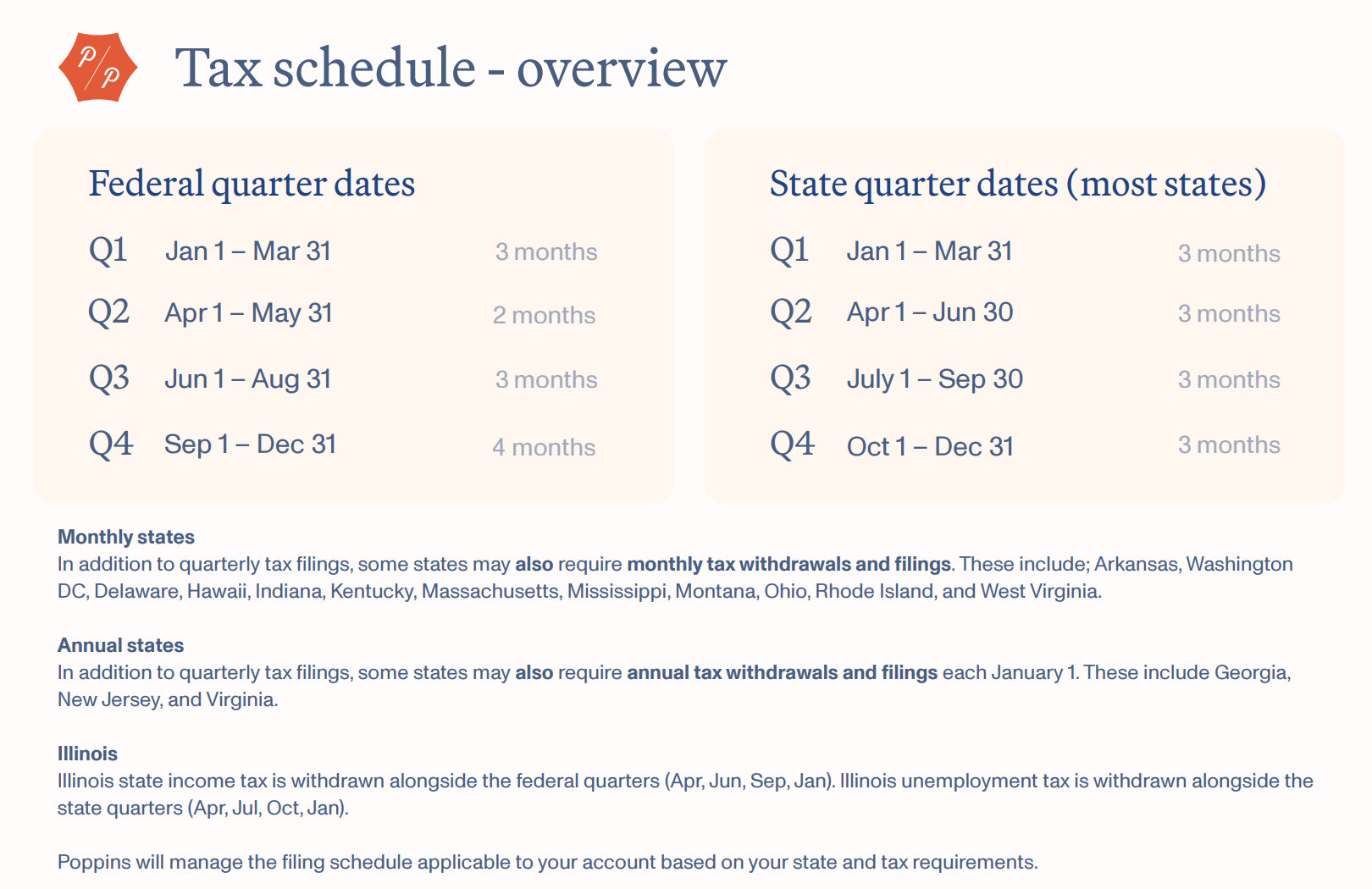
Federal household employment taxes follow four uneven filing windows, while most states use standard calendar quarters. In most states, that adds up to six withdrawals a year (January, April, June, July, September, and October). Some states add monthly or annual payments on top.
Quarterly schedule: federal vs. most states
State exceptions
Poppins tracks the schedule for your state and manages every withdrawal and filing.
How federal taxes are scheduled
Federal household employment taxes are filed quarterly, but "quarterly" doesn't mean an even three months each time:
This lines up with the IRS's standard estimated-tax due dates (Form 1040-ES), rather than a plain calendar quarter.
“You can pay all the employment taxes at once or you can pay them in installments.”
Household employment taxes reported on Schedule H are typically paid alongside your regular estimated tax payments, and those payments fall on set dates (mid-April, mid-June, mid-September, and mid-January) rather than on three-month intervals. The federal "quarters" are really just the windows of pay that lead up to each of those due dates, which is why Q2 is short and Q4 is long.
How most states are scheduled
Most states run their own quarterly household tax filings on a cleaner, calendar-quarter schedule:
Because these dates land about a month after the federal quarter closes, employers in most states end up filing twice a month apart — once for federal, once for state — rather than in a single combined payment.
A few states break from that pattern:
States with monthly withholding
Twelve states require household employer state income tax more often than quarterly. Employers in these states file state income tax monthly, on top of the regular quarterly federal and state filings. This will mean 12 smaller payments a year instead of a single larger one. The total tax owed doesn’t change; it’s just spread across more, smaller filings:
- Arkansas
- Washington, D.C.
- Delaware
- Hawaii
- Indiana
- Kentucky
- Massachusetts
- Mississippi
- Montana
- Ohio
- Rhode Island
- West Virginia
States with an added annual pull
A few states add a single annual payment on top of their usual schedule, and the specifics vary for each state:
- Connecticut and Virginia add an annual state income tax payment each January, on top of their regular state quarterly filing.
- Georgia adds an annual state unemployment tax payment each January, also on top of its regular state quarterly filing.
- New Jersey skips quarterly state filing altogether. Instead, its state taxes are combined into a single annual payment each January.
Illinois' split schedule
Illinois runs on two clocks at once. State income tax follows the federal quarterly schedule (April, June, September, and January), while state unemployment tax follows the state quarterly schedule (April, July, October, and January). Employers in Illinois end up with withdrawals that don't line up with either pattern on its own. Both are running, just offset from each other by about a month.
Poppins juggles these overlapping schedules for you, state exceptions included, so each withdrawal and filing lands on schedule. Get started with Poppins.
Keeping track of it all
Keeping track of all the different federal and state tax schedules probably isn’t your idea of a good time. Once you're set up, Poppins tracks your state's specific schedule and manages the withdrawals and filings tied to it, so you're not the one cross-referencing federal and state calendars every quarter. Get started with Poppins.
For a closer look at how W-2s, Schedule H, and year-end household employment tax filing fit together, see our Household Tax Season Guide. You can also download our full tax schedule overview.
Useful links
Federal tax deadlines and filing guidance
- IRS Publication 926 — Household Employer's Tax Guide
- IRS Form 1040-ES — Estimated Tax for Individuals
- IRS Publication 505 — Tax Withholding and Estimated Tax
Poppins Payroll guidelines