.png)

Hiring a summer nanny is exciting, until you start Googling "do I have to pay taxes on a summer nanny?" and end up with seventeen browser tabs and way more questions than you started with.
But the good news is once you break it down, it’s simpler than it looks. Here's everything you need to know about hiring, paying, and setting up a summer nanny the right way.
How a summer nanny arrangement is different from a year-round hire
The employment rules are identical: a summer nanny is a household employee just like a full-year nanny, but the contract, pay structure, and expectations have a few meaningful differences worth calling out explicitly:
- Fixed end date. A year-round contract is typically open-ended. A summer contract should include an exact end date ("this agreement covers June 2 through Aug. 22, 2026"). Without it, there's real ambiguity about when things wrap up and what notice is owed on either side.
- Guaranteed hours matter more than you'd expect. Because the engagement is short, a nanny taking a summer-only role needs to know they'll be paid even when your plans shift: a long weekend away, a last-minute trip, a week at the in-laws. A guaranteed-hours clause protects their income and protects you from a situation where they leave mid-July because the schedule got too unpredictable. This often matters more to a candidate than a slight bump in hourly rate.
- PTO is minimal or none. A two-month arrangement doesn't work the same way as a year-round role. Be explicit up front: Does your nanny get any paid days off? What about the Fourth of July? If you're going on vacation and don't need them, are those days paid or unpaid?
- No automatic severance at a defined end date. When both parties agree to a specific end date and the arrangement runs its course, there's no expectation of additional severance. That said, if either party ends things early, your contract should spell out what notice and payment is owed. Clarity here saves everyone a headache later.
What does a summer nanny do?
A summer nanny covers the gap when school's out and your usual childcare routine doesn't stretch far enough. The role looks a lot like year-round nanny work, supervision, activities, meals, transportation, but summer schedules tend to run longer and less structured. A nanny who worked 25 hours a week during the school year might be managing 45+ hours in the summer. That shift has real implications for pay and overtime, which we'll get into below.
If you're hiring a nanny specifically for the summer, it's worth putting a fresh contract in place, even if they worked with you during the school year. Summer is a distinct arrangement and deserves to be treated like one.
Is a summer nanny a household employee?
Under IRS rules, if you control how and when your nanny works (not just the end result), they're a household employee, not an independent contractor. That's true whether they work all year or just for summer.
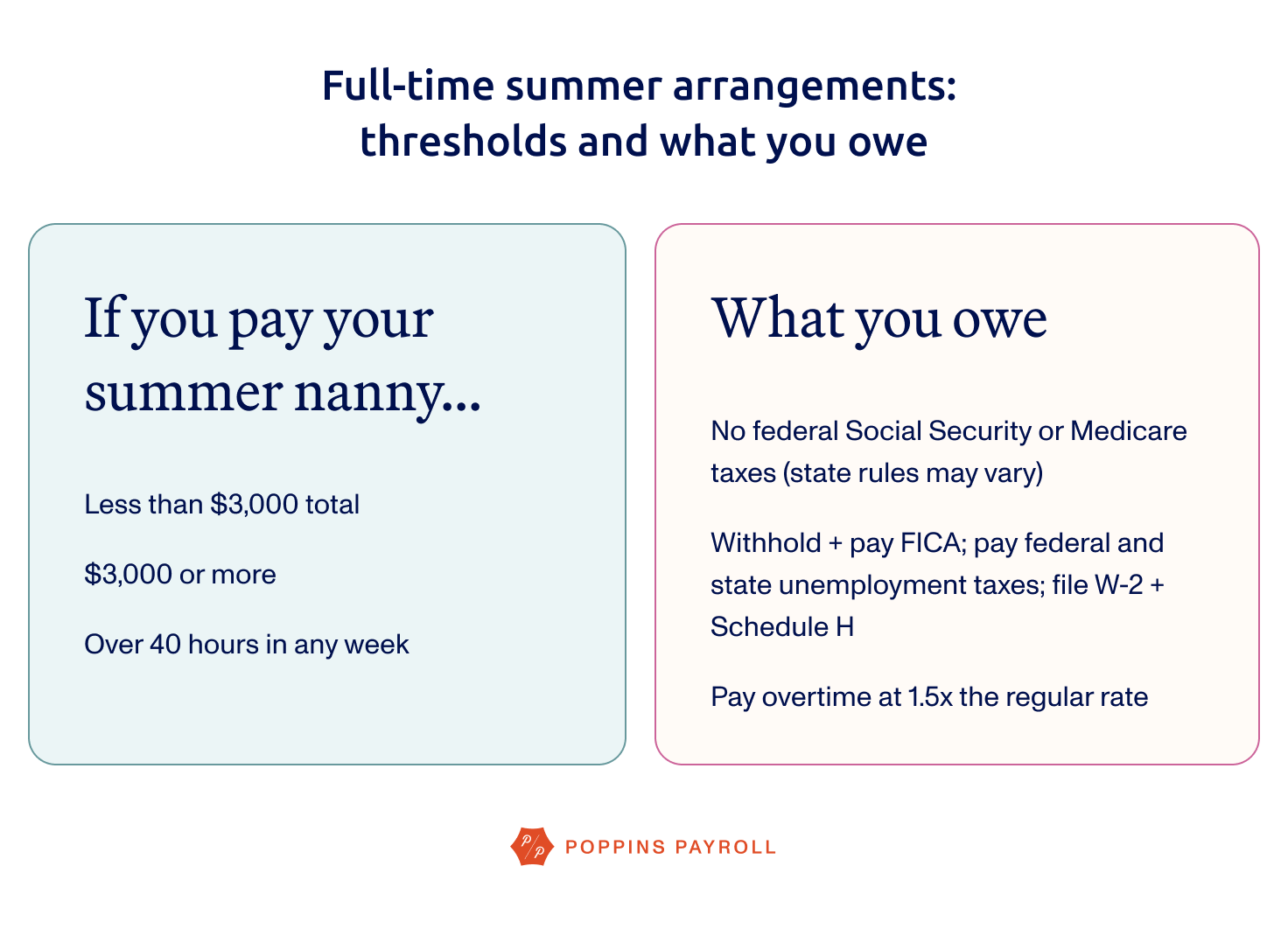
Whether you owe household employment taxes depends on how much you pay them. The 2026 federal threshold is $3,000. If you pay your summer nanny $3,000 or more over the course of the year (or more than $1,000 in any single quarter), certain federal employment taxes apply according to the IRS. Once you cross that threshold, here's what it means:
- Withholding Social Security and Medicare (FICA) from their paycheck
- Paying your own share of FICA on top of their wages
- Likely paying federal and state unemployment taxes
- Filing a Schedule H with your tax return
If you stay under $3,000 for the year or $1,000 in a quarter, you generally won’t owe federal Social Security, Medicare, or federal unemployment (FUTA) taxes. Some state rules may still apply, so it's worth a quick check. You're not required to withhold federal income tax unless your nanny requests it, but if they do, have them complete a W-4. Either way, keep records of what you paid.
Most full-time summer arrangements cross the threshold fast. A nanny working 40 hours a week for six weeks at the national average rate of $26.24/hour earns around $6,300, well over the $3,000 threshold. If that's your situation, you'll want to set up household payroll.

Not sure where you land? Poppins can help you figure it out →
What to pay a summer nanny
Rates vary by location, experience, the number of kids, and what you're asking them to do. A few things to keep in mind:
Typical hourly rates: Expect to pay roughly $21-$27/hour in most markets in 2026. The national average nanny rate is $26.24/hour according to UrbanSitter's January 2026 booking data, and Care.com's 2026 Cost of Care Report puts average posted rates between $21.30 and $27.27/hour nationally, with significant variation by city. San Francisco averages $29.44/hour, Seattle $27.14, Brooklyn $24.76, and San Antonio $18.84. An experienced nanny with CPR certification or specialized skills will typically land higher. What matters most: know your local market, be competitive, and spell out exactly what the role involves in the contract.
2026 Summer nanny hourly rates by city tier
Sources: UrbanSitter 2026 booking data; Care.com 2026 Cost of Care Report. Overtime = 1.5x base rate per FLSA. Certification premium based on PayScale data (+$1-$3/hr for CPR/First Aid).
See full city-by-city breakdown →
Summer hours = more hours. A nanny who worked 25 hours a week during the school year may shift to 45+ hours in the summer. That matters because any hours over 40 in a workweek must be paid at overtime, 1.5x the regular rate. You can't get around that by paying a flat weekly "salary" unless you follow specific legal rules under the FLSA. When in doubt, pay hourly.
Travel days. If the nanny travels with your family, those hours generally count as paid work time. Map out the expectations before the season starts, not after.
Paid days off. Most nannies expect paid holidays. Independence Day falls right in the middle of summer, so address it in the contract. If you're going on vacation and don't need them, your contract should say clearly whether those days are paid or unpaid.
Write a summer nanny contract, even for six weeks
A written contract isn't just for year-round arrangements. For a summer hire, it's actually more important, since short-term arrangements leave more room for misunderstandings about schedules, pay, and what happens when plans change.
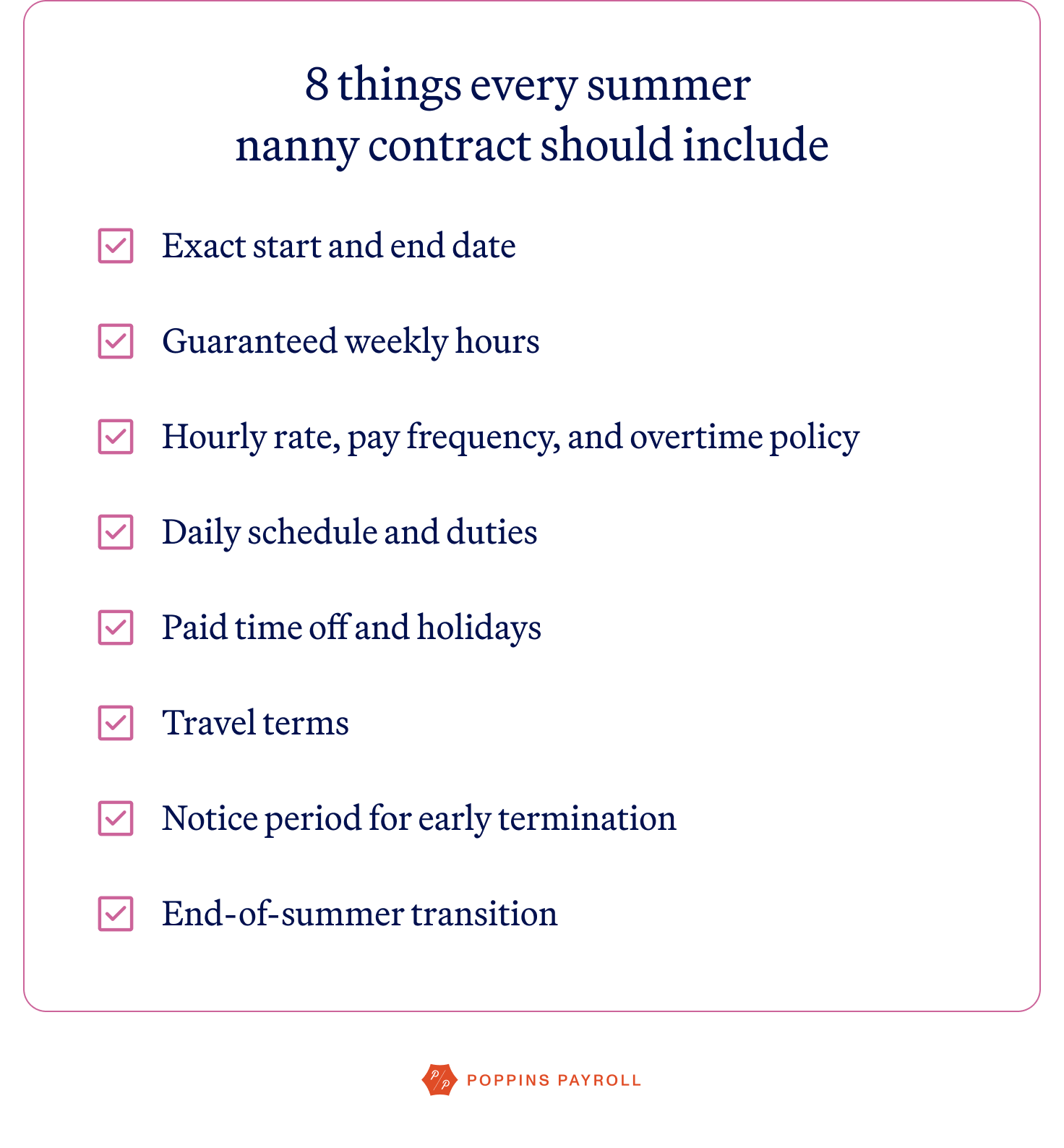
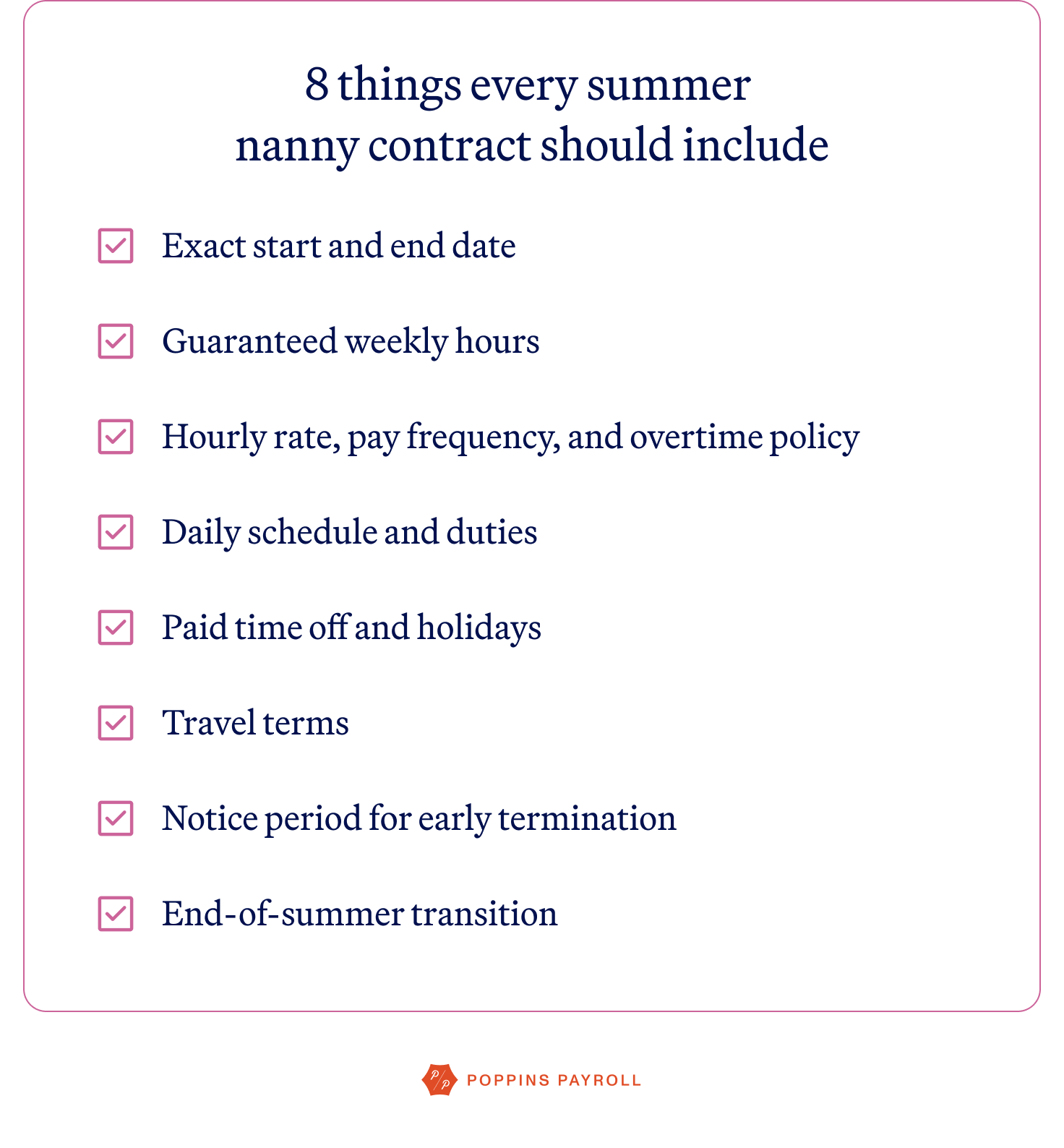
8 Things every summer nanny contract should include
1. Exact start and end date
e.g. "This agreement covers June 2 through Aug. 22, 2026." Vague language like "end of summer" creates disputes.
2. Guaranteed weekly hours
Minimum paid hours even if your schedule shifts. Protects the nanny's income and keeps them committed through the end.
3. Hourly rate, pay frequency, and overtime policy
State the base rate, pay schedule (weekly or biweekly), and the overtime rate (1.5x for hours over 40/week).
4. Daily schedule and duties
Hours per day, days per week, and a clear list of responsibilities: childcare, driving, activities, any light household tasks related to the kids.
5. Paid time off and holidays
Specify which days are paid (e.g., July 4th) and any PTO policy. For a 10-week arrangement, one to two paid sick days is typical.
6. Travel terms
If the nanny travels with your family — destinations, duration, compensation during travel days, and any expense reimbursement.
7. Notice period for early termination
How much notice each party gives if plans change before the end date. One to two weeks is standard for a short-term arrangement.
8. End-of-summer transition
Will you rehire next summer? What's expected in the final week? Clarity here makes the wrap-up smooth for both sides.
Already have a standard nanny contract? You don't need to start from scratch. Poppins' sample nanny contract covers the standard structure. Add an explicit end date, guaranteed hours, and the summer-specific terms above, and you're set.
Download Poppins' sample nanny contract →
What about paying a family member informally?
This one comes up a lot. The short answer: you can, but it doesn't make the taxes disappear.
If you pay a family member to watch your kids over the summer, the same IRS rules apply unless it's your own child under 21, your spouse, or your parent. A niece, a cousin, a neighbor's college kid? They're a household employee.
Cash and Venmo payments are still taxable income. Without a W-2, they lose Social Security credits and may have a harder time documenting income for future loans, rental applications, or other financial needs. Whether you pay in cash, Venmo, or check, the IRS treats them all the same. The method doesn't change what's owed and doing it right protects both of you.
How to set up payroll for a summer nanny
If you'll meet the federal tax thresholds or want to pay your nanny legally, the good news is you don't have to figure this out alone. To get started, you’ll need an Employer Identification Number (EIN). If you've hired a household employee before, you may already have one. You'll also need your nanny's completed Form W-4 and Form I-9, and state unemployment registration. Depending on your state, you may also need to register for state unemployment and other employer tax accounts.
Poppins handles the EIN registration for first-time employers, state account setup (where applicable), payroll processing, tax calculations, and year-end W-2 and Schedule H filing. If this is your first time, we'll walk you through every step.
For $49/month with no setup fee and no long-term commitment, Poppins runs the full stack so you don't have to become a part-time HR department just for the summer. When summer's over, you can cancel anytime.
What Poppins handles for you:
- EIN registration and state account setup
- Payroll processing and direct deposit
- Payroll tax calculations, including FICA and applicable federal and state taxes where applicable
- Quarterly tax filings
- Year-end W-2 preparation and filing
- Schedule H for your personal tax return
Pricing: $49/month for one household employee, $10/month for each additional. No enrollment fee. No year-end surprise charges. Cancel anytime.
Support: If you have a question, you can reach a real person. 98% of calls answered in under 90 seconds.
Poppins Payroll has saved my sanity. It's affordable, easy-to-use, and allows me to spend time with my kids instead of fussing with an Excel spreadsheet. So worth it!" - Alyx Williams, UT
A summer nanny may be a short commitment, but the payroll rules are the same as for any household employee. Write the contract, lock in the details, and let Poppins handle the rest. Your nanny is covered, you're covered, and nobody's untangling a tax headache in January.
This post is for general informational purposes only and does not constitute legal or tax advice. Consult a qualified professional for guidance specific to your situation. Tax thresholds and rules are subject to annual change; confirm current figures at IRS.gov.