For many families, the cost of childcare can require creative measures to make it work. That’s why many families are exploring a nanny share—a fun solution that pairs complementary families and schedules to share the cost and care provided by one nanny.
A nanny share can be a win-win-win: it’s cost-effective and flexible for parents and creates opportunities for social interaction for children.
This guide will ensure you structure your nanny share for success by understanding how it works, the benefits and challenges, and the steps to setting up the best arrangement for everyone involved.
What is a nanny share?
A nanny share is when two (or more) families share the services of a single nanny. There are two common arrangements:
1. One nanny shared between families: The nanny cares for two or more children simultaneously, typically in one home, with the option to rotate between homes. While there is potential for some flexibility in the schedule, the nanny’s hours are typically defined and shared between the families.
2. 1-on-1 nanny split between families: Another scenario could be where families split one nanny's full-time hours, with the nanny caring for the children at one home one-on-one in the morning (e.g., 8 a.m. to 1 p.m.) and the other in the afternoon with the other family (e.g., 1 p.m. to 6 p.m.).
Either outcome allows families to share the benefits of a private nanny with added benefits like reduced costs.
How does a nanny share work?
When setting up a nanny share, several questions may come up that you’ll want to outline and connect on before finalizing the arrangement with your nanny. A written nanny contract with a Nanny Share Addendum keeps everyone on the same page throughout your nanny’s tenure. This makes open communication between the families easier with a document to fall back on. Here are some ground rules to cover and agree upon before getting started:
- Location: Where will the nanny share take place? Will the care happen at one home, or will it rotate between two households?
- Supplies and equipment: How will the cost of food, diapers, and other essential items be handled?
- Sick days: How many sick days will the nanny receive? How will a child’s sickness be handled? At what point will the children be able to be together again?
- Vacations and PTO: What are the expectations when the families take time off? How much PTO will the nanny receive? Which days will be provided as paid holidays?
- Legal and tax implications: Both families are employers, which means you must address taxes, contracts, and possibly workers’ compensation. It's essential to understand and comply with the legal requirements for a nanny share from the outset. Be sure to check out Poppins FAQs for all your nanny taxes for a nanny share to ensure your bases are covered.
- Conflict resolution: How will any disagreements be handled? A written agreement can help keep everyone on the same page and prevent any misunderstandings. Agreements also help to outline what happens in terms of notice to give if it doesn’t work out or as needs change.
The benefits of a nanny share
Nanny shares offer many advantages for families looking for quality care for their little ones without breaking the bank. Here are just some of the benefits:
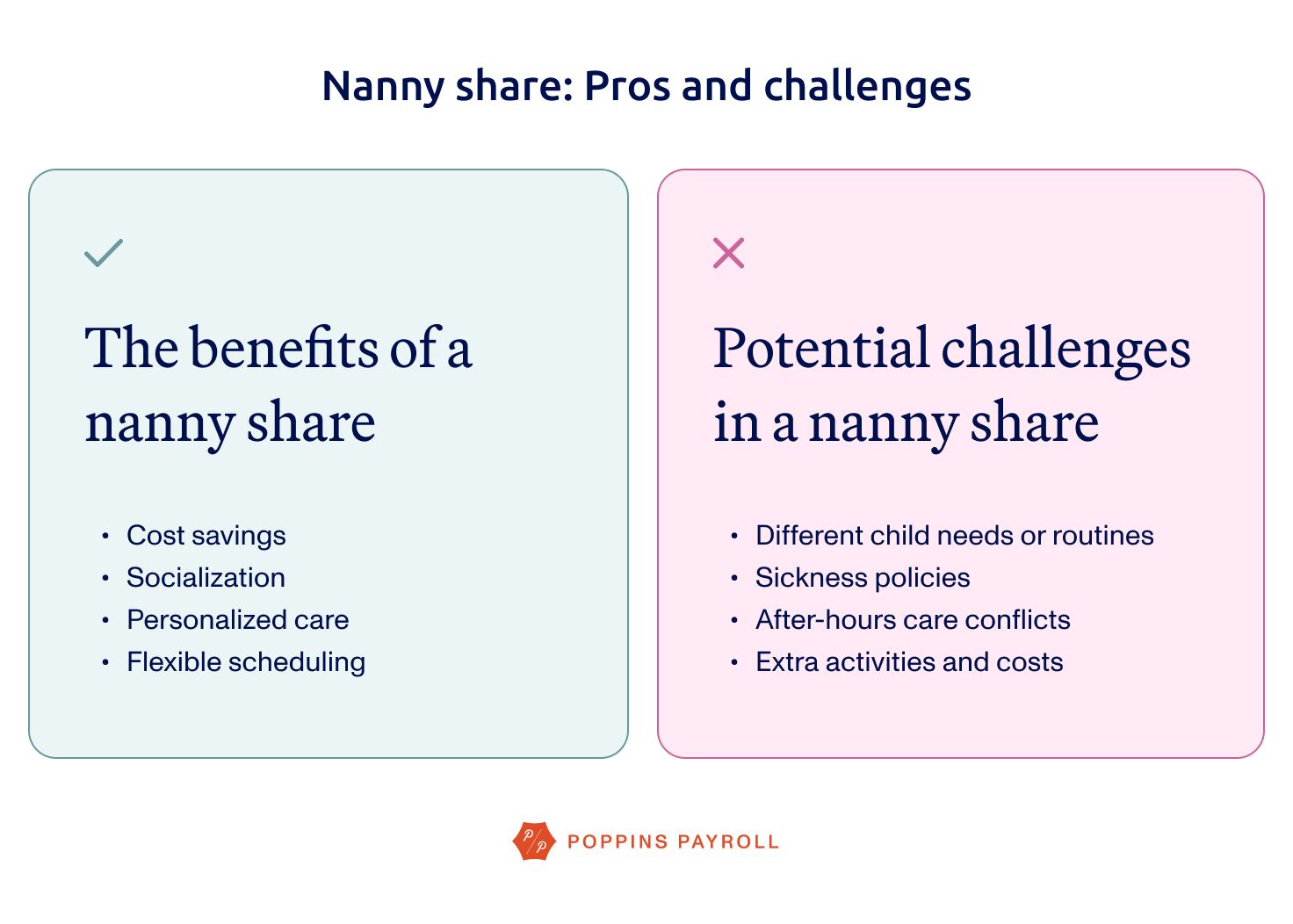
- Cost savings: Sharing a nanny can cut your costs by up to 30-40 percent, making the coordination and communication upfront all the more worth it. Nannies typically charge more to care for two children vs one, but the savings are still considerable.
- Socialization: Studies have shown a strong correlation between early socialization experiences, particularly within the family and peer groups, and a child's ability to adapt to school. A nanny share can help children develop a bestie at a young age and make it easier to adapt to more group settings as they get older, as is outlined by one family in this article.
- Personalized care: With fewer children to care for than a larger daycare setting, your nanny can provide individualized attention, tailoring care to each child more easily. This often also means fewer sick days for both the child and their parents.
- Flexible scheduling: When an agreement is done well, families can factor in occasional date nights or after-hours care, making it easier for families with varying work schedules.
While flexibility is required on both sides, ensuring that each family’s values, routines, and expectations align can make the arrangement a success. One family shared the benefits of a nanny share and how they were able to save money while their son gained a new best friend.
The average nanny share cost in the US
Understanding costs is a crucial part of determining whether a nanny share is right for your family. According to UrbanSitter, nanny pay rates vary by state, with higher averages in major metropolitan areas. While Poppins Payroll doesn't publish specific nanny rate data, our platform does offer helpful tax-specific breakdowns by state, which can be useful for estimating your total employer cost.
To provide a national snapshot, here’s what a nanny share looks like in terms of cost compared to hiring a private nanny, using UrbanSitter’s averages from two major states:
A real-world example: Nanny share cost in Chicago
Let’s break it down even further with a hypothetical scenario in Chicago, a major city in the Midwest. According to UrbanSitter, the average hourly rate for a nanny in Chicago is about $22.21/hour for one child. In a nanny share, nannies typically charge about 1.3x their solo rate to care for two children from different families.
If a nanny’s base rate is $22.21/hour, the nanny's share rate would be approximately $28.87/hour. That rate is then split between two families:
- Solo private nanny rate: $22.21/hour x 40 hours x 52 weeks = ~$46,000 per year for one family
- Nanny share rate: $28.87/hour total, paid by both families combined x 40 hours x 52 weeks = ~$60,000 per year split between two families
- Cost per family: $14.44/hour (~$30,000/year) — the nanny earns more overall, while each family pays less than the solo rate
That’s a savings of about $16,000 per family annually — roughly over $1,300 back in your budget every month — while still receiving premium, in-home care, and added social benefits for the children.
These savings are why many families consider the extra coordination of a nanny share well worth the effort.
How to pay compliantly in a nanny share
When participating in a nanny share, it’s important to ensure each family becomes a legal household employer to pay your nanny fairly. As UrbanSitter puts it plainly:
You become an employer when you hire a full-time nanny. That’s true whether you’re the only family paying, or splitting the cost with another.
In a share agreement, each family is independently responsible for fulfilling household employer obligations, and:
- Each family must pay their share of the nanny’s wages
- Must withhold and remit taxes (i.e., Social Security, Medicare, federal/state unemployment, and income tax if applicable)
- Provide a W-2 at year-end
- Comply with employment laws, including minimum wage, overtime, and workers’ compensation where required
Poppins Payroll easily supports nanny share agreements by helping each family to pay different nanny rates and calculating the split taxes accordingly. All nanny payroll taxes are withheld and filed on your behalf. No more headaches come tax time! Year-end W-2s and Schedule H forms are generated and sent automatically, along with workers' comp— helping families meet their household payroll tax obligations.x
How to find a nanny share
Finding the right nanny share arrangement begins with finding the right families to partner with. Here are some great ways to get started:
- Word of mouth: Talk to friends, family, and colleagues. Often, the best nanny shares start with personal recommendations. Start with socializing your search at local doctor’s offices, community centers, or parent groups.
- Online platforms and agencies: Websites like UrbanSitter and other nanny share networks can help you connect with families in your area.
- Social media groups: Many cities have parent or child care groups on Facebook or other social platforms where you can post your interest in a nanny share.
Qualities to look for in a nanny share family
Once you’ve socialized your search, the next step is to vet good families to partner with on nanny shares. Here are some key good qualities to look for:
- Similar parenting philosophies: Make sure you align on core values like discipline, screen time, and routines.
- Compatible schedules: Look for families with similar childcare needs and working hours.
- Children of similar ages: Kids close in age are more likely to play well together and benefit socially.
- Strong communication: Open, respectful communication is essential for navigating inevitable changes and challenges.
- Convenient location: Proximity matters. A nearby family, along with a nanny with a reasonable commute, makes logistics easier—especially during traffic or unexpected delays.
- Aligned expectations around working hours: Clarify early whether your nanny needs to drive, work late occasionally, or start early. A shared calendar and aligned expectations can help your nanny share run smoothly.
Finding a nanny share that works well can feel like finding a needle in a haystack. But when both families are aligned from the start, it’s far easier to find the right match and create a nurturing, stable care environment.
Qualities to look for in a nanny for your nanny share
According to a Parenting.com article on successful nanny shares, some important factors that can greatly impact the consistency of help and wellness for your kids that are specific to nanny shares include discussions around how sick days will be handled, as well as regular check-ins to ensure communication is open and everyone remains on the same page.
Some great qualities to look for in a nanny are:
- Passion: Dive into their inspiration to become a nanny.
- Safety: Ask about how they’ll keep children safe when they're on duty.
- Experience: The more scenarios your nanny has been in watching multiple children, the better they’ll be able to handle anything that comes up with your children.
- Adaptability: Remaining adaptable will allow your nanny to properly adjust to both family's needs and maintain good communication.
- Trust: The more you can trust someone else with the care of your kids, the better you’ll be able to step away and focus on the areas you need to.
Our article on the interview questions to ask your nanny breaks down nine categories you can vet to ensure you find the best possible fit for your family.
Potential challenges in a nanny share
As with any shared arrangement, nanny shares can come with some unique challenges. After all,
The nanny has to meet the expectations of two completely different sets of parents. (NannyCounsel)
That dynamic is exactly why clear, upfront agreements matter. Common friction points include:
- Different child needs or routines: One child may require more outdoor time while another needs longer naps. These differences can create tension if the nanny’s time and energy are felt to be unevenly distributed.
- Sickness policies: Families may have different comfort levels around exposure to illness. For example, one family may be fine with a runny nose, while another expects a full recovery before a child rejoins.
- After-hours care conflicts: If both families occasionally require evening coverage, it can be challenging to determine whose needs take priority. A clear system for requesting and compensating after-hours care is key.
- Extra activities and costs: One family may want the nanny to take their child to classes or extracurriculars that require additional payment, while the other prefers to keep costs low. Be clear upfront on what’s included and what’s optional.
Good communication and a well-written agreement can help you address many of these scenarios before they become problems. Establish expectations early—and revisit them regularly to keep the nanny share running smoothly.
Screening a nanny and another family for a nanny share
When screening another family for a nanny share, it’s critical that you align on all the big stuff so you don’t need to sweat the small issues. Here are 10 top questions you might want to ask to align on everything and vet fit before you start:
- What are your views on screen time?
- How do you approach discipline and boundaries with your kids?
- Do you follow any dietary restrictions with your kids?
- What are your typical working hours, and is it flexible?
- What’s an average schedule and needs for your family?
- How do you want to approach travel time and PTO?
- Any family rules to be aware of?
- How do you want to handle pay each week or month?
- Are you open to using a payroll system that handles all tax and other required documentation for us at the outset?
- Are you open to ongoing check-ins to ensure everything is going smoothly?
Ready to take the next step to find a nanny share?
Ready to take the next step toward affordable, personalized childcare? Sign up with Poppins to take the stress out of paying and dealing with all the logistics of a nanny share for you. With Poppins, it even allows each family to pay different hourly rates and takes all the headaches out of tax filings and workers' compensation, thanks to our fantastic partnerships and more.
Empower your childcare solution and join the growing community of families who have discovered the secret to cutting childcare costs in half—all while giving your kids the best care and a built-in playdate!
Useful resources
Cost data & finding a match
- UrbanSitter nanny cost data
- Nanny pay and cost guide for 2026
- NannyCounsel: how nanny share rates work
Real family experiences
- Parents.com: how we pulled off the perfect nanny share
- Business Insider: nanny share benefits
- NIH/PMC: early socialization and school adaptation
From Poppins Payroll
.png)